
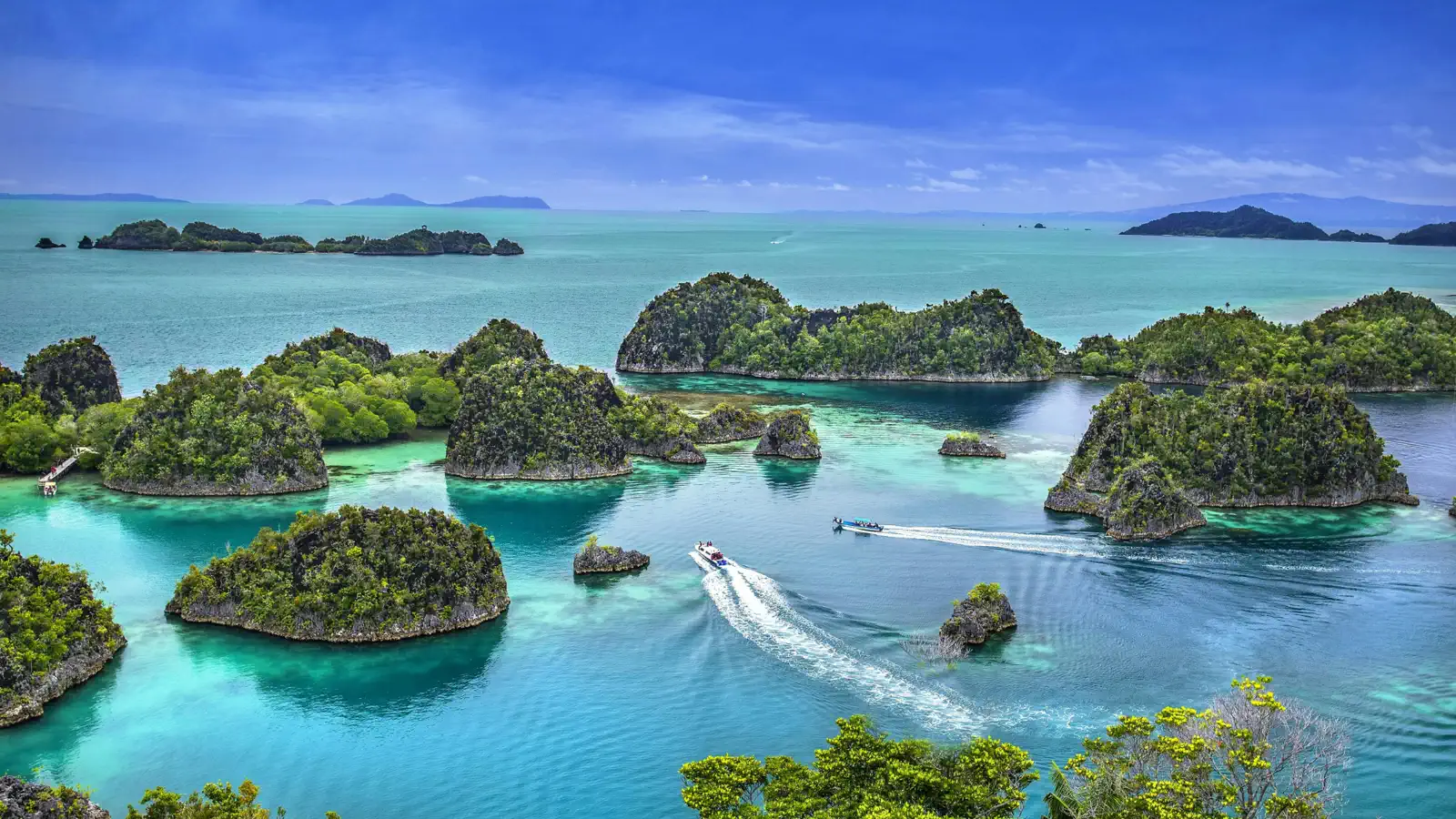
Choosing the right Raja Ampat trip is less about finding a “better” side of the archipelago and more about matching the route to your travel style. Northern Raja Ampat suits travelers drawn to dramatic karst scenery, island-hopping, and iconic viewpoints, while southern Raja Ampat, around Misool, is especially compelling for those who want marine life, diving, and secluded limestone landscapes at the heart of the journey.
Raja Ampat at a Glance
Raja Ampat lies in Southwest Papua at the heart of the Coral Triangle. UNESCO describes the Raja Ampat Global Geopark as covering 36,660 square kilometers and four primary islands: Waigeo, Batanta, Salawati, and Misool. The Yacht Club Indonesia notes that these “Four Kings” are surrounded by roughly 1,500 rugged islands. The regional geopark authority also highlights that Raja Ampat is home to around 75% of the world’s known coral species.
For yacht travelers, the practical choice is often between a northern route built around Waigeo, Wayag and nearby island groups, or a southern route focused on Misool. Longer itineraries can cover more ground, but shorter charters usually benefit from a clearer geographic focus. Wayag lies at the northern end of the geopark, while Misool occupies its southern region.
Choose North Raja Ampat for Scenery and Variety
Northern Raja Ampat is an excellent match for first-time visitors who want the classic landscapes seen in photographs. Wayag sits in the northernmost part of the geopark and is known for its clusters of limestone islands rising from tropical water. The region rewards travelers who enjoy viewpoint hikes, kayaking, tender excursions, beaches, and slow island-hopping.
A northern Raja Ampat trip can also incorporate Kri, Penemu, Arborek, and Mansuar, depending on the route. The Yacht Club Indonesia’s seven-day sample itinerary, for example, travels from Sorong through Kri Peninsula, Penemu, Wayag, Wofoh, Arborek, and Mansuar before returning to Sorong.
This variety makes the north attractive to mixed groups. One guest may want to dive, another may prefer snorkeling, while others may focus on photography or land excursions. Traveling by yacht in Indonesia allows the group to move between these experiences without changing accommodation every day.
Choose South Raja Ampat for Misool and Marine Life
Southern Raja Ampat centers on Misool, the southernmost of Raja Ampat’s four main islands. UNESCO identifies Misool as one of the archipelago’s major karst landscapes, while conservation sources describe Southeast Misool as a large marine protected area of ancient limestone islands, channels, and marine lakes.
For divers and underwater photographers, the south is particularly appealing. Misool is known for rich reefs, dramatic underwater topography, reef sharks, and manta ray encounters. Magic Mountain in southern Misool, for example, is documented as a manta cleaning station surrounded by schooling fish, soft corals, and reef sharks. A south-focused Raja Ampat trip also suits travelers who enjoy exploring narrow channels, lagoons, and remote limestone formations between dives.
Because Misool is remote, travelers researching yacht charter options in Indonesia can use a private yacht to stay closer to the areas they want to explore instead of returning to a fixed base. For those considering a luxury private yacht experience in Indonesia, the journey can combine diving and snorkeling with private cabins, onboard dining, and flexible daily plans.
Which Side Matches Your Travel Style?
Choose the north if your priorities are panoramic scenery, Wayag, island-hopping, and a broad mix of activities. It can work especially well for couples, families, or groups where not everyone wants to dive every day.
Choose the south if your holiday revolves around reefs, underwater photography, Misool’s limestone labyrinth, and time in remote marine environments. Travelers researching a dive-oriented holiday in Raja Ampat may find the southern route especially rewarding. Misool forms the southern region of Raja Ampat and includes extensive protected reef environments.
If privacy and flexibility matter most, a Raja Ampat boat charter can make either region more personal. The route can be adjusted to suit guests’ interests and conditions rather than following a rigid group schedule.
How Many Days Do You Need?
The Yacht Club Indonesia currently presents sample Raja Ampat itineraries ranging from seven days and six nights to twelve days and eleven nights. A shorter journey can work well for a focused northern route, while extra days allow more time to travel slowly or reach more distant areas.
Trying to cover too much territory can turn a remote-island holiday into a transit-heavy schedule. When planning a Raja Ampat luxury cruise, prioritizing fewer meaningful locations often creates a better balance between cruising and activities.
A Raja Ampat private charter is especially useful for longer journeys because it allows plans to adapt to weather, sea conditions, and guest preferences. The Yacht Club Indonesia recommends visiting Raja Ampat between November and April and uses Sorong’s Domine Eduard Osok Airport as its gateway.
Can You Combine North and South Raja Ampat?
Yes, but it makes most sense with enough time. Wayag lies in the far north while Misool is in the south, so combining them requires considerably more cruising than staying within one region.
A longer itinerary can reveal an appealing contrast: Wayag’s iconic karst panoramas and northern island-hopping followed by Misool’s reefs, lagoons, and marine-focused exploration. For shorter journeys, choosing one region usually means more time for diving, snorkeling, hiking, or relaxing and less time underway.
Which Raja Ampat Should You Choose?
There is no universal winner. North Raja Ampat suits travelers seeking famous landscapes, varied activities, and a strong first introduction to the archipelago. South Raja Ampat suits travelers who want Misool, diving, and marine biodiversity to define the journey.
The best Raja Ampat trip is the one built around how you actually want to spend your days. Start with your priorities: diving, photography, hiking, family time, privacy, or slow exploration, and choose the route that gives those experiences enough time to unfold.